
Die Hard
- Tony Garcia-Meyer

- Nov 29, 2022
- 5 min read
Updated: Nov 11, 2023
The Greatest Action Film of All Time
On July 22nd, 1988, the world was blessed with a magical story of bombs, guns, blood, and yippee-ki-yay's. The John McTiernan directed film stars the one and only Bruce Willis as the proud and stout "John McClane" who defends hostages in the Nakatomi Plaza from a terrorist group led by Alan Rickman's "Hans Gruber." Since then, the film has exploded with success, chiefly due to its incredible action-packed sequences, its larger-than-life characters, and its powerful themes of love and redemption.
Lights, Camera, Action! Action! Action!
Few other films can compare their action scenes to the brilliantly shot and edited masterpiece that is the roof-top sequence in Die Hard. I could tell you about it here, but you just gotta watch it first.
This scene encapsulates so much about what the action is like in Die Hard. There are several notable scenes within the movie, but this one represents the action in the fullest way.
Firstly, we have the dramatic misunderstanding that leads the FBI to shoot at McClane, this makes the audience angry. Secondly, we have the establishment that the roof is about to blow with McClane on it, simultaneously, the FBI is flying back around in their helicopter to shoot him down, instilling fear within the audience. Thirdly, we get Willis' perfect comedic delivery as McClane is noticing this bizzare situation he's in, the audience laughs. McClane bounds off the rooftop and the audience sits on the edge of their seats in the tension of the moment, questioning if he'll get off the rooftop and back into the building in time. The tension finally breaks as McClane unties the hose from his torso and is safe at last.
The audience is relieved.
Action scenes are only effective if you are taken through different levels, if the stakes have finally risen high enough for this new climactic development to occur. This scene perfectly brings the audience through these emotions of balanced levity and gravity to buildup to a climax. Every action sequence is its own movie and just like a plot, this scene starts small, with establishing shots to inform the audience of what might happen, then takes us through the worsening situations, building up the threat level and tension until we cannot even imagine a good ending before, finally, a conclusion is found.
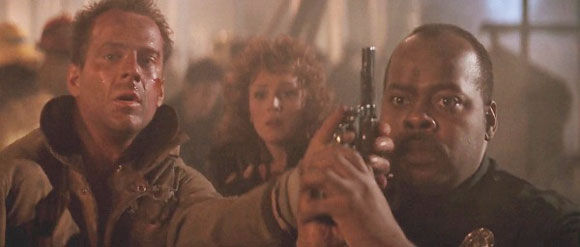
John McClane, Al Powell, and Hans Gruber.
For a film sporting a 2 hour runtime and taking place only in one location, an awful lot of characters are introduced. Strangely enough, it works. The best characters in the film are ones that are developed in such a way that the audience likes them despite their flaws. Here are some honorable mentions, before I go into depth about the main characters:
Argyle
Ellis
White Johnson
Black Johnson
Theo
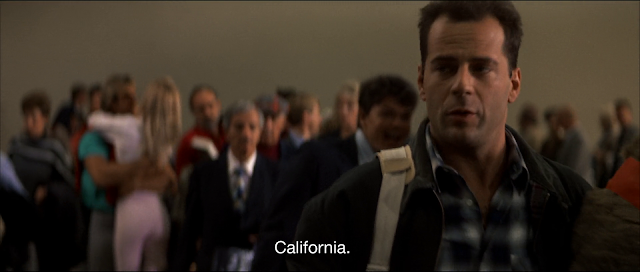
John McClane is somewhat of a prideful jerk at the start of the film. The viewer instantly notices his skeptic, sarcastic attitude, yet is unbothered. Why? Because a main character in any film must be liked at the start of a film, even if you grow to dislike him. What I mean by "liked" is very different from what we generally "like" outside of cinema. For example, at the beginning of the film, McClane constantly alludes to his distaste for California and loves poking fun at it. As this develops, we see that most of it has to do with the fact that he's unsupportive of his wife's decision to start her career there. Also, McClane, a New York cop, has a lot of pride in his city and going all the way out to the west coast by plane has left him awfully cranky.
Let's face it, a person like "Act One McClane" would be largely disliked. But screenwriters know just the right amount of "cantankerous grump" you can have in a character balanced out with his "suave hero" attitude to make him pop right out of the screen.
We like McClane all the same, though we see his character develop throughout the film, among many explosions, gunshots, and shards of glass. He starts out like this until, by act three, he gets his act together and has a touching conversation with his fellow cop, over the radio, Al Powell.

Though I hate to say it, Al Powell has the same loveable charisma as Winnie the Pooh. He brings nothing to the table consisting of actual skills, since he's not actually that great a police officer. He brings no interesting power dynamic or threat against the antagonists. He can't even influence his police chief. Powell is mostly a dope with a big diabetic heart. Despite this all, he's an integral character to the story, because he plays the main character's friend.
Action films that put a character like John McClane through the ringer, need a character like Powell to bring not only comedic relief but a simple sign to the protagonist that everything is gonna be okay. He's the encouragement that the audience and McClane need to make it through all the drama and disappointment.
However, he has a powerful story of redemption in his own right. During a radio conversation with McClane, Powell mentions that he had accidentally shot a kid in the line of duty, and that because of this, he lost the courage to draw his firearm and could no longer work as a field officer. But, in the end, Powell musters the courage to save McClane's life by shooting down the final remaining terrorist. We all applaud that McClane lived, but, really, we were all just glad Powell got his moment to prove himself.
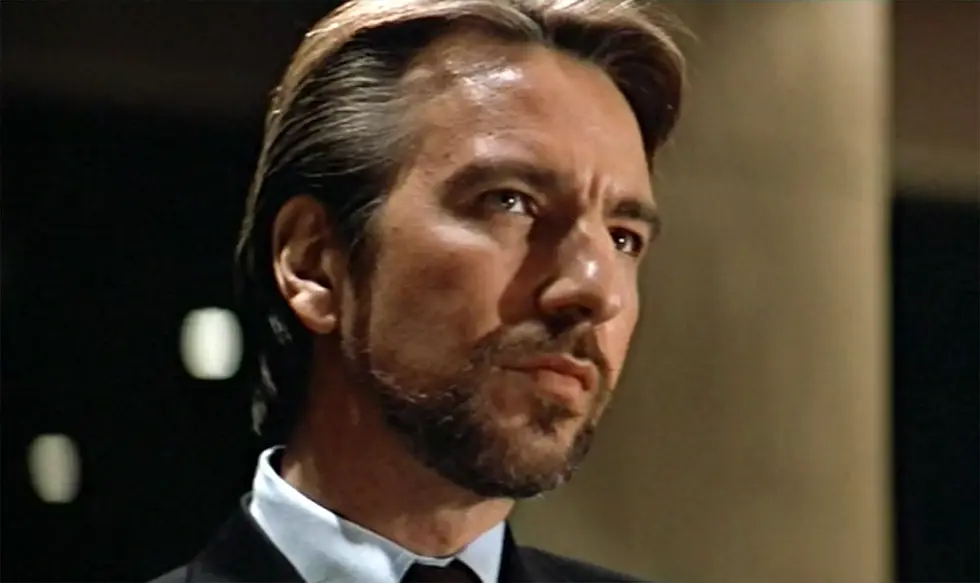
Possibly the greatest action villain of all time, Hans Gruber was played by the late and great, Alan Rickman. A perfect voice and line-delivery, the nice-guy facade, and a keen interest in men's fashion make Hans Gruber the first of his kind. 1980's cinema was filled with unmemorable villains, but Hans stuck in people's minds. Here, I will list each key moment in the film that cemented him in time.
When he counts to three before he shoots Takagi and actually follows through.
When he changed his accent to trick McClane.
When he negotiates with the FBI carelessly, and says he's an exceptional thief.
When he repeated McClane's catchphrase, "Yippe-ki-yay motherfucker."
When he fell from Nakatomi Plaza in slow motion... Happy trails, Hans!
Hans was written with just as much care as John McClane. In a film that truly pits two characters against each other, we have to see and understand both characters and both motives. Hans is a money-grubbing lowlife who acts like a member of the elite. He acts like he cares about a higher cause and wants to be remembered in this way. He even holds hostages in a relatively kind and reasonable fashion, bringing a sofa out for them, bringing them to the bathroom, and addressing everyone in a calm and appropriate way. Hans truly acts like a civilized and proper gentleman, but when he's pushed to his limits by McClane's antics, he resorts to scrappiness and thuggery. This two-sidedness of the character makes him unique to many 80's bad guys, who were often written like angry brick walls, like Biff Tannen in Back to the Future, Darth Vader in Star Wars, or the Principal in Breakfast Club.
None of us can forget that this legendary antagonist is foiled by Christmas gift-wrapping tape and a woman's wristwatch.
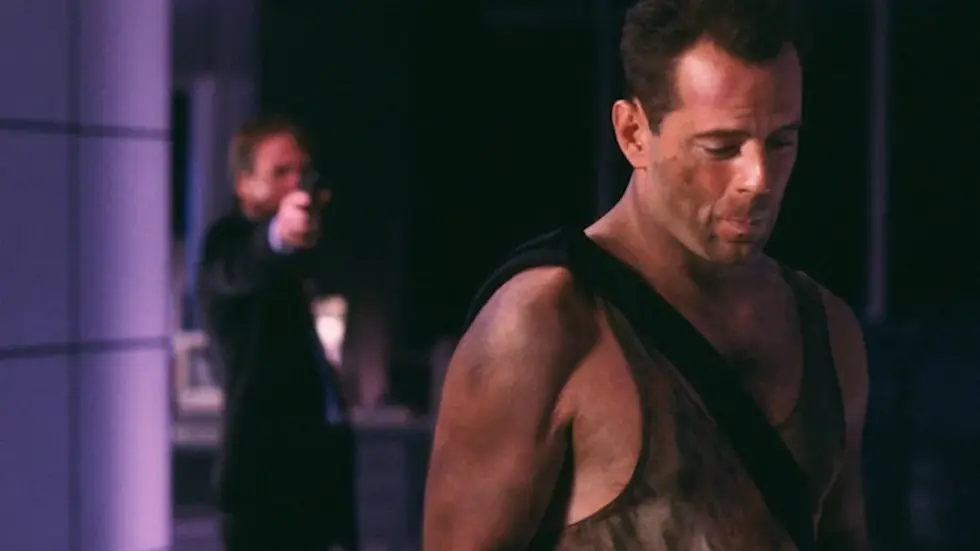
In the end, Die Hard is a beautiful Christmas story about love and redemption. Holly and John McClane get back together, Powell rediscovers his courage, and McClane and Powell become great friends in the darkest of times. If you haven't thought about adding this movie to your Christmas traditions, maybe you should consider it.
Celebrate the most wonderful time of the year with this equal parts heroic and badass movie with friends and family. Go out to the coast, get together, have a few laughs!

Comments